
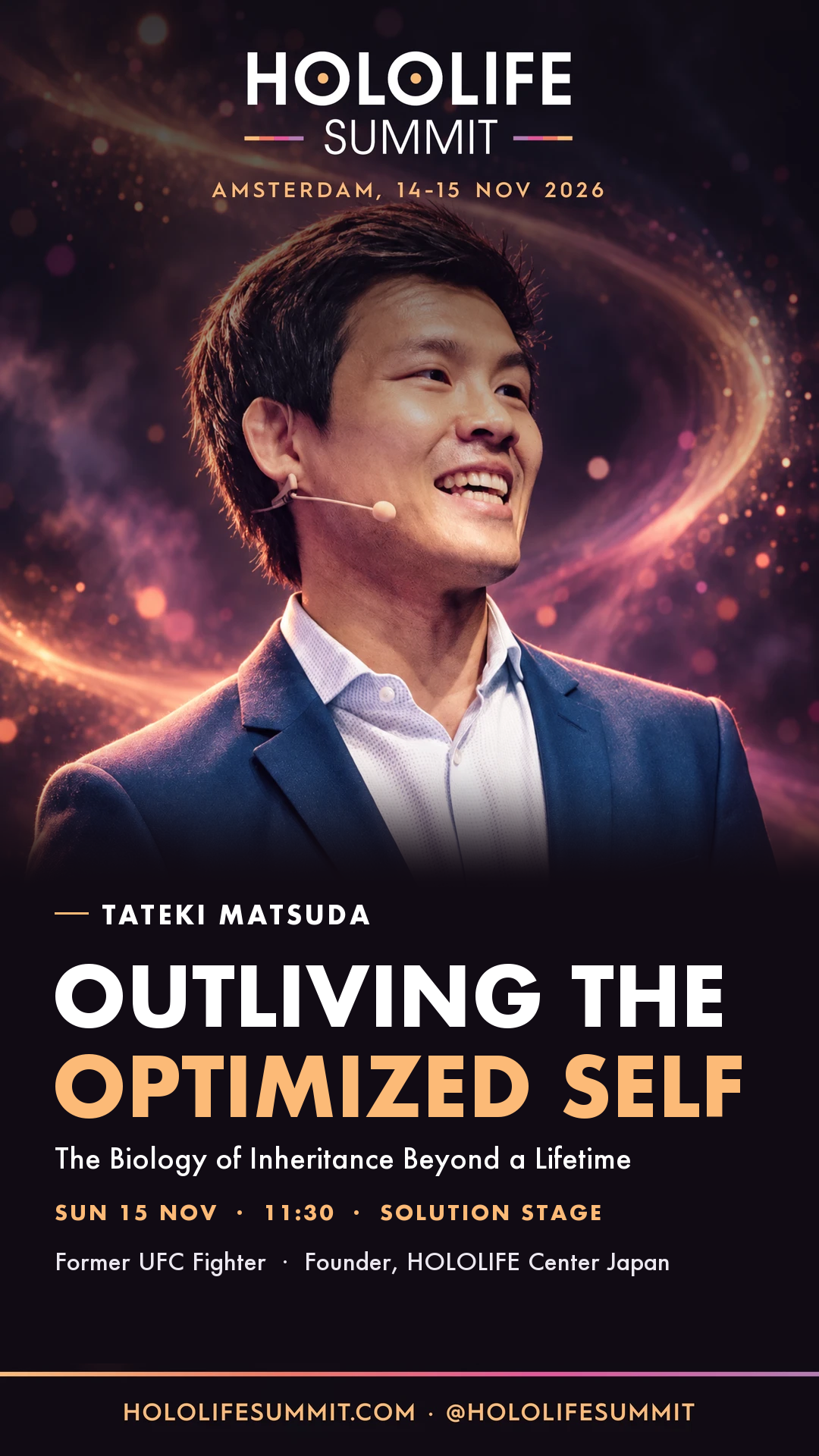
The Biology of Inheritance Beyond a Lifetime
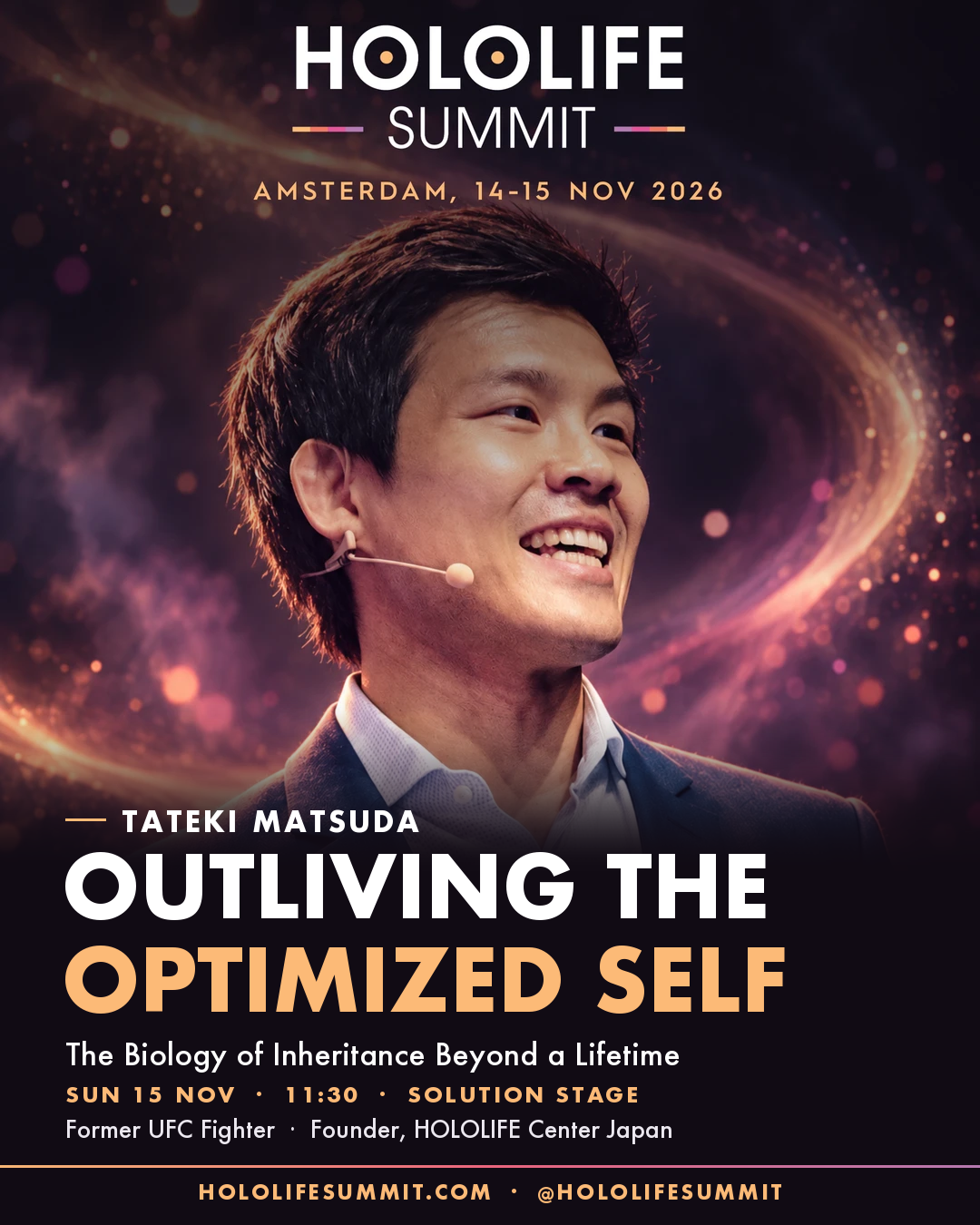
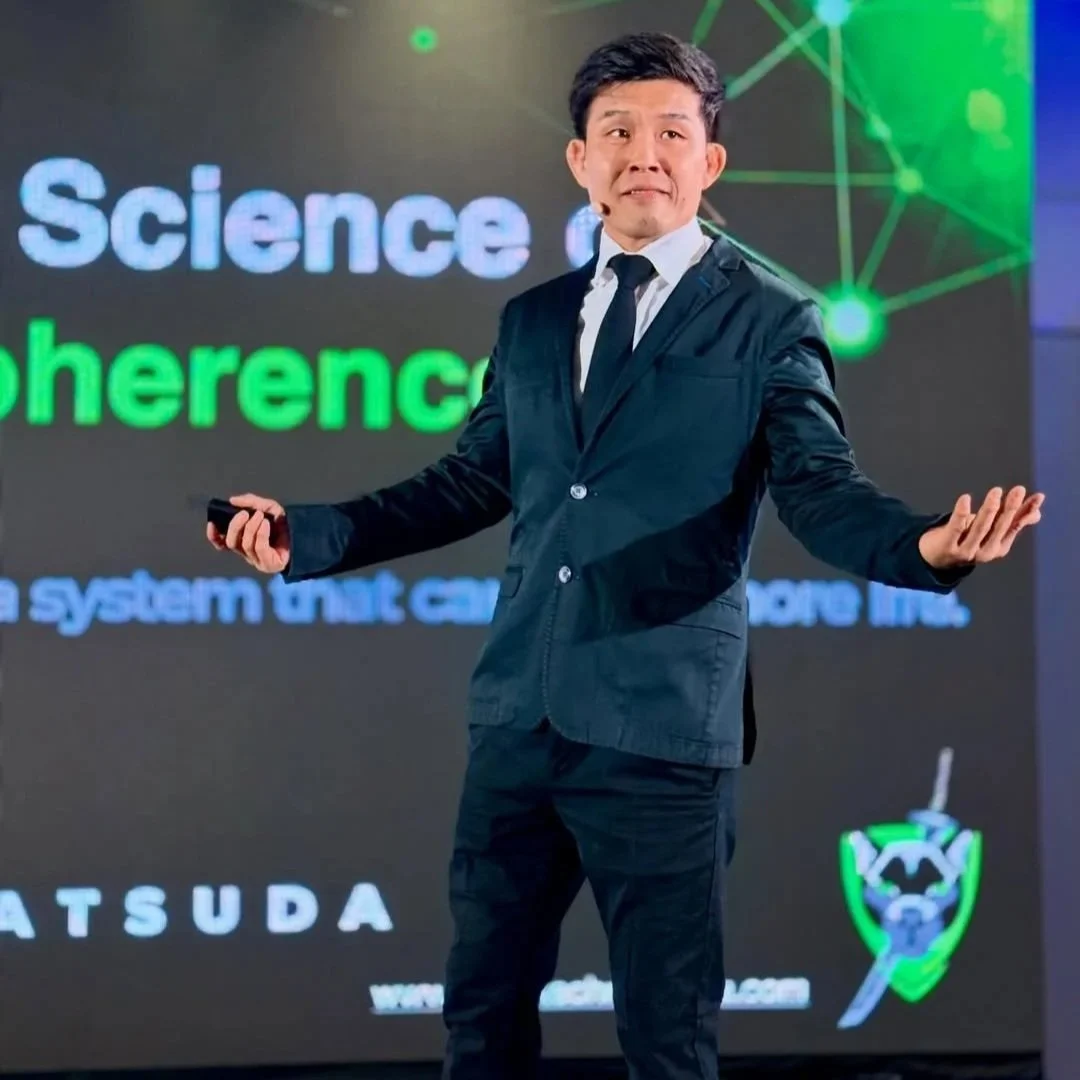
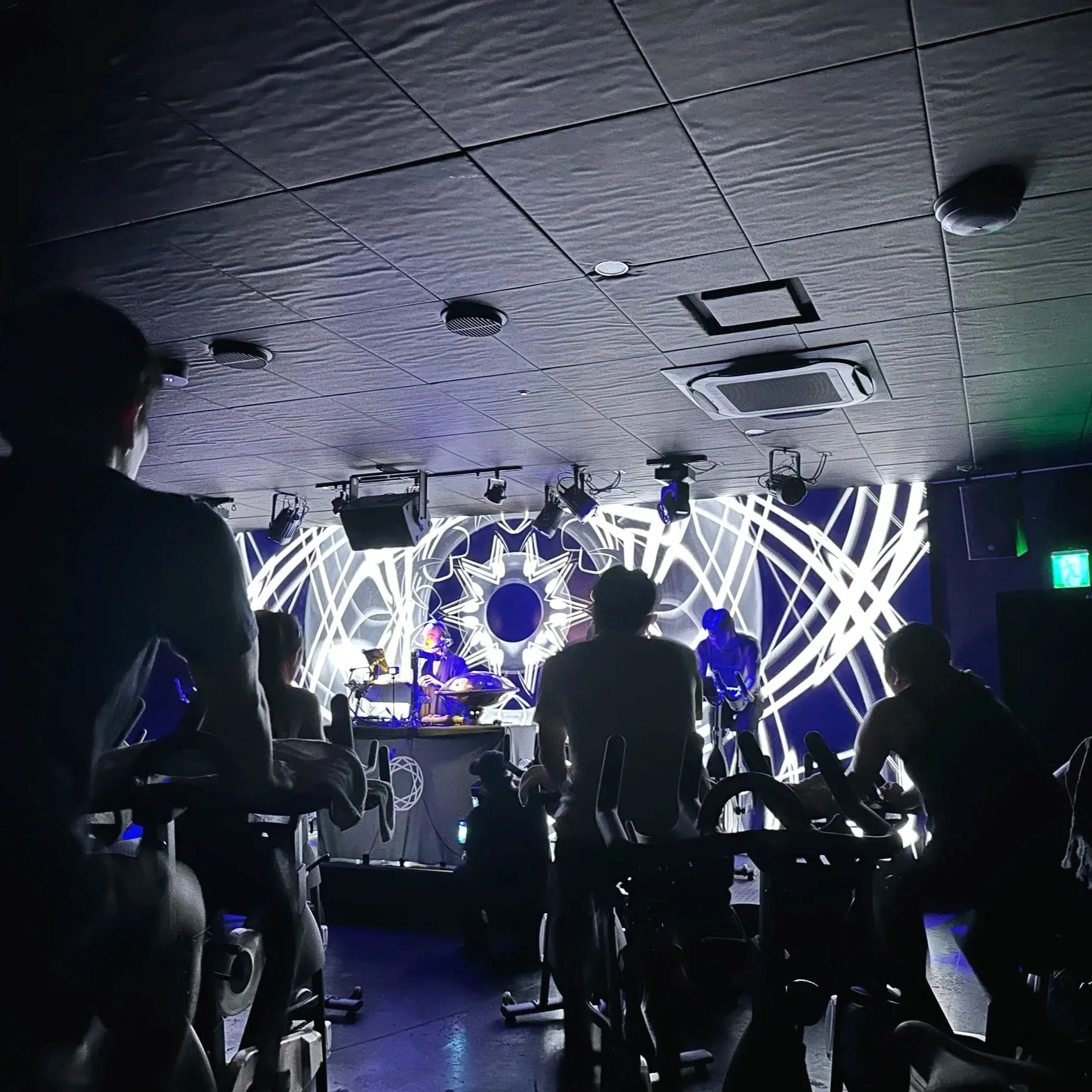
HOLOLIFE Summit 2026 · Solution Stage · November 15, 2026 · Amsterdam, Netherlands
Talk companion, show notes, references & study guide
By Tateki Matsuda
What will your health make possible for someone else?
That question opens and closes my talk at HOLOLIFE Summit 2026 Amsterdam, where this year’s theme is Life Beyond a Lifetime.
I was a professional fighter. For nearly twenty years I organized my life around a number on a scale, and then around everything else I could measure. The optimized self is real. I am not here to say it is wrong. I am here to say it is incomplete.
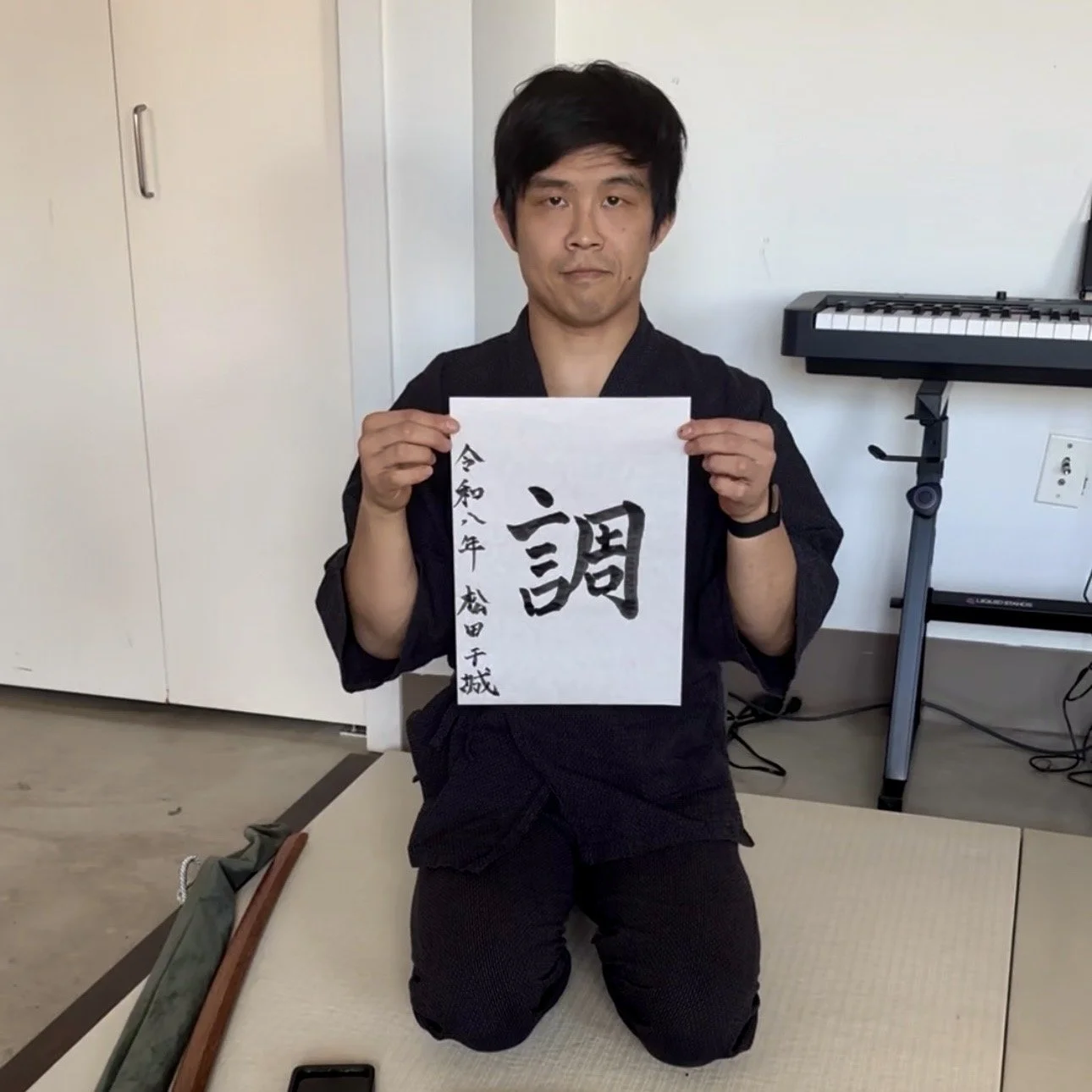
In this talk I read the summit’s theme the Japanese way, through five words: 道 dō, 先 saki, おかげさま okagesama, 自他共栄 jita kyōei and 恩送り on-okuri. Next to each word I put published research, with its limits.
This page follows the talk, then opens it up for further study. Every paper I mention on stage is listed below, with its main limitation written next to it, so that anyone in the audience can check my homework. The connections I draw between that research, my experience and the Japanese language are my interpretation.
Quick Show Notes & Takeaways
The optimized self is real. It is incomplete. Measuring a body well does not answer who that body is for.
Nobody got there by aiming at it. The long-lived people I grew up around did not have a protocol. A review of sport studies points the same way for performance: goals about the next action showed the largest effect, goals about the result the smallest.
道 Dō is a road, not a destination. Judo is the gentle way, not the gentle goal. Nobody arrives. You walk it.
先 Saki puts the future behind you. One character means both “ahead” and “before”. You face what you received. The future arrives from behind your back.
Received is not decided. Famine studies suggest early environments can leave biological traces. Pooled studies of childhood adversity and epigenetic clocks show no consistent link.
Relationships leave traces you can count. Across 148 studies, stronger social relationships went with about one and a half times the odds of survival. The studies are observational.
Handing something on can be trained. Older adults who tutored children in a two-year randomized trial reported a stronger sense of contributing to the next generation.
The biology is a whisper, not a shout. “Contribute and you will live longer” is not what the evidence says. Nobody’s worth is measured by how useful they are.
For Whom?
The talk opens with two weigh-ins: 135 pounds and 125 pounds. Professional fighting taught me to organize my life around a number on a scale. The scale first. Then food, water, sleep, training. If it could be measured, I measured it. My life became a protocol.
Then there was a number I was not training for. After years of weight cuts and hard camps, a doctor had to tell me what they had done to my hormones. I knew how to push my body. I had much more to learn about caring for it. I wrote about that period in The Missing Variable.
Then one question showed up that no lab test could answer. I had this body. I had made it as good as I knew how. For whom?
Whose life was any different because this body was in good shape? I did not have an answer.
Nobody Got There by Aiming at It
Here is something I noticed. Nobody I know became long-lived by trying to become long-lived. The old people I grew up around in Japan did not have a protocol. They had a garden. A neighbour. A job they never quite retired from. A long life happened behind their back, while they were looking at something else.
That is an observation from my own life. It is not a statistic.
I know it from the cage too. I never won a fight by thinking about winning. If you see the punch, you react too late. What wins is the next step. The distance. The breath. The hands.
Sport psychology has tested a version of this. A 2022 review pooled twenty-seven studies on goal setting in sport. The largest effect on performance came from process goals: the next action. The smallest came from outcome goals, such as winning.
The studies in that review differ from one another, so it is not a head-to-head contest. And clear, difficult goals do improve performance. So I am not saying “don’t have a goal”. I am saying: don’t stare at it.
道 · Dō: The Way
You know this word already. Jūdō. Kendō. Aikidō. Dō means the way, the road. Judo is “the gentle way”. Not the gentle goal. Nobody arrives at judo. You walk it.
The summit describes longevity as more than how long we live. It is also, in the summit’s words, “how far it reaches beyond us.”
A long life is not a place you reach. It is a trace you leave behind you. The optimized self aims at the result. The Japanese way faces the road.
和時計 · Wadokei: You Don’t Move. Time Comes.
Think of a clock. On a Western clock, the hand moves. You are the hand. You run around the dial, chasing the next hour.
Japan had a different clock, the 和時計 wadokei. On the one I show in the talk, the hand does not move. The dial turns. You don’t move. Time comes.
Look at how we write “future”: 未来 mirai. Two characters. Not yet. Come. You do not go and get it. It arrives.
To master your time is not to control it. It is to synchronize with it. I explored this clock in more depth in Japanese Chrono Trigger: Rethinking Time and Longevity.
先 · Saki: The Future Is Behind You
Saki is one character. It means “ahead”. この先 kono saki: from here on, the future.
The same character appears in 先祖 senzo, the ancestors, and in 先生 sensei, the teacher. Literally, “the one born before”. In my language, the ancestors and the future share one word.
So I see the past in front of me. The future is behind me. You face what you received. You can see it. The future comes from behind your back. You can only feel it coming.
That is my Japanese reading of this summit’s theme. Life beyond a lifetime is not ahead of you, in some technology. It is behind you. Your kids. Your students. The next person in the gym. The question is: who is standing behind you?
This is one fighter’s reading of his own language. It is not a claim about how every Japanese speaker thinks.
Three more words follow. Each comes with two studies, and their limits.
おかげさま · Okagesama: The Body You Received
Ask a Japanese person how they are, and a very common answer is “okagesama de”. It means “I’m well, thanks to…”, and then the sentence stops. Okage means shade. Shelter. You are well because you have been standing in somebody’s shade.
Professional fighting made me radically self-accountable. If it went wrong, it was my fault. Nobody else’s. And if it went well? Everybody’s doing. The coaches, the sparring partners, the people who fed me and gave me their time. In Japanese that is one word.
A grandparent’s hunger, a grandchild’s heart. In Överkalix, a village in Sweden, researchers matched a century of harvest records to family trees. How much food a paternal grandfather had as a boy tracked with the mortality of his grandsons. A later paper from the same village linked sharp swings in a paternal grandmother’s childhood food supply to cardiovascular deaths in her granddaughters.
This is one village, with small numbers, observational records and very wide confidence intervals. How the signal travels, if it travels, is a hypothesis. It is not a finding.
Sixty years later, the mark was still there. In the winter of 1944–45, the Netherlands went through the Hunger Winter. Six decades later, people conceived during the famine showed less methylation of one gene, IGF2, than their unexposed siblings.
One gene. One cohort. And this is the person’s own time in the womb. It is not something handed to the next generation.
When researchers pooled the studies on childhood adversity and epigenetic clocks, there was no consistent link. So: received is not decided. Okagesama is gratitude. It is not fatalism.
自他共栄 · Jita Kyōei: The Body Between Us
Jita means self and others. Kyōei means flourishing together. The phrase comes from Kanō Jigorō, the founder of judo, who set it beside 精力善用 seiryoku zen’yō, the best use of one’s energy. That second phrase sounds like optimization. Kanō did not let it stand alone.
You can see it in any dojo. You cannot practice a throw by yourself. Somebody has to let you throw them. A few hundred times. Then you do the same for them. Your progress is literally made of other people’s bodies.
Relationships leave traces you can count. A meta-analysis pooled 148 studies and about three hundred thousand people. Those with stronger social relationships had about one and a half times the odds of being alive at the end of follow-up.
The studies are observational. Nobody can randomize people into loneliness.
Kindness, measured in the blood. In a randomized trial, 182 adults spent four weeks doing kind things for other people, doing kind things for themselves, or simply writing down their day. Researchers looked at a pattern of immune gene expression that rises under chronic stress. The group doing kind things for other people showed a lower level of that pattern afterwards than the controls. Kindness toward oneself did not show the same change among those who did it as instructed.
This is gene expression, measured over five weeks. It is not disease. It is not lifespan.
For nearly twenty years I asked what I was putting into this body. This study asks who I am doing something for. Nobody in that trial was aiming at their immune system. They were aiming at somebody else.
恩送り · On-okuri: The Life We Pass On
恩 on is a kindness you received. 送り okuri means to send it on. 恩返し on-gaeshi is paying a kindness back. On-okuri is for when you cannot. You give it to someone else. Forward. To someone who cannot pay you back either.
On-okuri is handing something over your shoulder, to the person behind you, without turning around.
A chair, a book, six years. In Japan, a programme called REPRINTS sends older adults into kindergartens and primary schools to read picture books to children. With MRI at the start and six years later, the readers kept their hippocampal volume. A comparison group lost some.
The study was not randomized. The imaging analysis included 59 people. Volume was maintained, not increased. Cognitive tests showed no difference. So this is not “reading to children prevents dementia”. Look at what the readers were aiming at. Not their hippocampus. The kids.
Can it be trained? In Baltimore, a two-year randomized trial assigned older adults to tutor children in city schools or to a control group. The tutors reported a stronger sense of contributing to the next generation. The more they took part, the stronger it was.
The outcome is self-reported. The paper has no blood, no scans and no lifespan. What it says to me: that feeling is not a personality trait. It can be trained. Like grip.
What I Learned the Hard Way
The talk asks one question for the person standing behind you. What have you learned that someone else should not have to learn the hard way?
I go first. Years of weight cuts and hard camps, and a doctor had to tell me what they had done to my hormones. I was pushing a body I had stopped listening to. The lesson is not “don’t cut weight”. The lesson is: the number you are chasing can hide the number that matters. I would like the next person not to find that out the way I did.
In the optimized self, that lesson is a line in a spreadsheet, and it dies with the spreadsheet. In on-okuri, it is the most valuable thing you own. It is the one thing the person behind you cannot get alone.
This is my personal history. It is not medical guidance.
Three Things, This Week
Three words. Three small things. None of them is a longevity goal. All of them can be done on a Tuesday.
おかげさま · Okagesama. Tell one person who built you what they gave you. While you still can.
自他共栄 · Jita kyōei. Take one role across generations. Read, coach, cook. Regularly.
恩送り · On-okuri. Teach one thing to someone who cannot pay you back. A recipe. A drill. A mistake.
This is not a new hack. “Contribute and you will live longer” is not what the evidence says. Nobody’s worth is measured by how useful they are. You choose this. The body just seems to notice when you do.
Five Words, One Breath
Near the end, one slide sets the optimized self beside what outlives it.
道 · Dō. The optimized self aims at the result. What outlives it walks the road.
先 · Saki. The optimized self faces the future, ahead. What outlives it faces what it received. The future comes from behind.
お陰様 · Okagesama. The optimized self says, “I built this body.” What outlives it says, “I received it.”
自他共栄 · Jita kyōei. The optimized self lives in one body. What outlives it lives between bodies.
恩送り · On-okuri. The optimized self ends with the spreadsheet. What outlives it is handed on, over your shoulder.
The optimized self is real. It is incomplete.
You Don’t Reach a Long Life. You Leave One.
In Nice this spring I asked a question I still cannot answer. What if I lived to 120, and one of my children died before me? More life also means more loss. You need the capacity to carry both. That talk is here: Beyond 120: The Missing Science of Human Coherence.
So here is where I land. Nobody got to a long life by aiming at it. You don’t reach a long life. You leave one. Behind you. In the people you faced while you walked.
I cannot tell you what the future will be. I am a fighter, not a fortune teller. I can tell you where it is.
Shownotes & Scientific References
These are the papers I speak about on stage, each with its main limitation. I read abstracts and, where I could, full texts. I am not an author of any of these papers, and none of them tests a Japanese word.
1. Aiming at the Next Action
Williamson O, Swann C, Bennett KJM, Bird MD, Goddard SG, Schweickle MJ, Jackman PC. The performance and psychological effects of goal setting in sport: A systematic review and meta-analysis. International Review of Sport and Exercise Psychology. 2024;17(2):1050–1078. Published online 2022.
Twenty-seven studies were pooled. Process goals showed the largest effect on performance and outcome goals the smallest. The studies differ in participants, comparisons and measures, so this is not a direct contest between goal types. An effect size is not a win rate.
2. Why Goals Still Matter
Locke EA, Latham GP. Building a practically useful theory of goal setting and task motivation: A 35-year odyssey. American Psychologist. 2002;57(9):705–717.
This is the other side of the argument. Goal-setting theory holds that specific, difficult goals improve performance, given commitment and feedback. I keep it next to the sport review on purpose. The question is where attention goes, not whether to have a goal.
3. A Grandfather’s Food Supply
Pembrey ME, et al. Sex-specific, male-line transgenerational responses in humans. European Journal of Human Genetics. 2006;14(2):159–166.
In historical records from Överkalix, Sweden, a paternal grandfather’s food supply in mid-childhood was associated with the mortality of his grandsons, and a paternal grandmother’s with that of her granddaughters. The data are observational, from one village, with small numbers. The route of transmission is the authors’ hypothesis.
4. A Grandmother’s Food Supply
Bygren LO, et al. Change in paternal grandmothers’ early food supply influenced cardiovascular mortality of the female grandchildren. BMC Genetics. 2014;15:12.
A follow-up in the same village linked sharp swings in a paternal grandmother’s childhood food supply to cardiovascular mortality in her sons’ daughters. The authors themselves describe the confidence interval as very wide. The other three grandparents showed no such response.
5. The Dutch Hunger Winter, Six Decades Later
Heijmans BT, et al. Persistent epigenetic differences associated with prenatal exposure to famine in humans. Proceedings of the National Academy of Sciences. 2008;105(44):17046–17049.
People exposed to the 1944–45 famine around conception showed less methylation of the IGF2 gene about sixty years later than their unexposed same-sex siblings. This is one gene in one cohort. It concerns the person’s own prenatal exposure, not inheritance across generations, and it does not show that the difference caused disease.
6. Childhood Adversity and Epigenetic Clocks
Russell H, et al. The impact of adverse childhood experiences on DNA methylation age: a systematic review and meta-analysis. Clinical Epigenetics. 2026;18(1):33.
Twenty-seven studies were reviewed and six were pooled. The pooled estimates do not support a robust association between adverse childhood experiences and epigenetic age acceleration. The studies are heterogeneous. “No consistent association” is not the same as “no effect”.
7. The People Around Us
Holt-Lunstad J, Smith TB, Layton JB. Social Relationships and Mortality Risk: A Meta-analytic Review. PLOS Medicine. 2010;7(7):e1000316.
Across 148 studies and 308,849 participants, stronger social relationships were associated with about 50 percent higher odds of survival. The association was strongest for rich measures of social integration, not simply for living with someone. The evidence is observational.
8. Kindness and Immune Gene Expression
Regan A, et al. The genomic impact of kindness to self vs. others: A randomized controlled trial. Brain, Behavior, and Immunity. 2022;106:40–48.
One hundred and eighty-two adults were randomized to kind acts for others, kind acts for themselves, or a daily-activity control, one day a week for four weeks. The group doing kind acts for others showed lower expression of a stress-related immune gene pattern than controls. The outcome is gene expression at five weeks. Disease and lifespan were not measured, and the result for self-directed kindness is open to interpretation.
9. Reading to Children for Six Years
Sakurai R, et al. Preventive effects of an intergenerational program on age-related hippocampal atrophy in older adults: The REPRINTS study. International Journal of Geriatric Psychiatry. 2018;33(2):e264–e272.
Older adults in Japan who read picture books to children for six years maintained their hippocampal volume, while the comparison group showed a decline. Participants chose their own group, the imaging analysis compared 17 readers with 42 controls, and cognitive function did not differ. Volume was maintained, not increased.
10. Tutoring Children for Two Years
Gruenewald TL, et al. The Baltimore Experience Corps Trial: Enhancing Generativity via Intergenerational Activity Engagement in Later Life. The Journals of Gerontology: Series B. 2016;71(4):661–670.
Older adults randomized to tutor children in schools reported a stronger desire to contribute to the next generation, and a stronger sense that they were doing so, across two years. More exposure went with larger effects. The outcomes are self-reported. Health, biological markers and mortality are outside this paper.
Further Reading
I read these while preparing and do not present them on stage. They are here so the picture is complete, including the ones that cut against the story.
The Brake: How Small the Effects Are
Hillmann AR, et al. Social role participation and inflammation: A meta-analytic examination of the shape of association and variability with age. Neuroscience & Biobehavioral Reviews. 2026;191:106962. Fifty studies. More social roles went with slightly lower inflammation, with an age-adjusted correlation of about −0.04. Abstract.
Martinez RL, et al. An extraverted behavior intervention improves immune gene expression. Brain, Behavior, and Immunity. 2026;134:106299. The pre-registered analysis was not significant. A secondary effect had faded a month later. Participants were mostly students. Abstract.
Weinstein N, Ryan RM. When helping helps: autonomous motivation for prosocial behavior and its influence on well-being for the helper and recipient. Journal of Personality and Social Psychology. 2010;98(2):222–244. Helping does the helper good mainly when it is freely chosen. Abstract.
Aiming, Habits and Happiness
Lally P, et al. How are habits formed: Modelling habit formation in the real world. European Journal of Social Psychology. 2010;40(6):998–1009. Ninety-six people, twelve weeks. Among those whose data fit the model well, reaching a plateau of automaticity took 18 to 254 days. Publisher record.
Gollwitzer PM, Sheeran P. Implementation intentions and goal achievement: A meta-analysis of effects and processes. Advances in Experimental Social Psychology. 2006;38:69–119. Across 94 tests, planning when and where to act had a medium-to-large effect on goal attainment. Publisher record.
Mauss IB, et al. Can seeking happiness make people unhappy? Paradoxical effects of valuing happiness. Emotion. 2011;11(4):807–815. Women nudged to value happiness highly reported less positive emotion after a pleasant film, and no difference after a sad one. Sixty-nine women, one laboratory, a few minutes of feeling. A hint, not a law. Abstract.
Harris DJ, et al. A systematic review and meta-analysis of the relationship between flow states and performance. International Review of Sport and Exercise Psychology. 2023;16(1):693–721. Twenty-two studies in sport and gaming, with a moderate correlation. The direction of causation is not settled. Publisher record.
Sheldon KM, Elliot AJ. Goal striving, need satisfaction, and longitudinal well-being: The self-concordance model. Journal of Personality and Social Psychology. 1999;76(3):482–497. Goals that fit a person’s own interests and values sustained effort and went with better well-being. Abstract.
Purpose, Volunteering and Mortality
All of these are observational.
Sone T, et al. Sense of life worth living (ikigai) and mortality in Japan: Ohsaki Study. Psychosomatic Medicine. 2008;70(6):709–715. Abstract.
Sutin A, et al. Purpose in life and mortality: A meta-analysis of the published literature and individual-participant data of 488,765 participants followed for up to 32 years. Psychological Medicine. 2026;56:e214. The association shrinks after adjustment for health behaviours and clinical factors, and persists. Abstract.
Okun MA, et al. Volunteering by older adults and risk of mortality: a meta-analysis. Psychology and Aging. 2013;28(2):564–577. Abstract.
Kim ES, et al. Volunteering and Subsequent Health and Well-Being in Older Adults: An Outcome-Wide Longitudinal Approach. American Journal of Preventive Medicine. 2020;59(2):176–186. Some outcomes moved. Many did not. Abstract.
Relationships and the Immune System
Bae Y, et al. Widowhood, immune aging, and mortality in older Americans: evidence from the US Health and Retirement Study. The Journals of Gerontology: Series A. 2026;81(7). Abstract.
Christakis NA, Fowler JH. The spread of obesity in a large social network over 32 years. New England Journal of Medicine. 2007;357(4):370–379. Debated: shared environments and choosing similar friends are alternative explanations. Abstract.
Stellar JE, et al. Positive affect and markers of inflammation: discrete positive emotions predict lower levels of inflammatory cytokines. Emotion. 2015;15(2):129–133. Cross-sectional and small. Abstract.
Piiroinen I, et al. Sense of Coherence and Mortality: A Systematic Review and Meta-Analysis. Psychosomatic Medicine. 2020;82(6):561–567. Abstract.
Chen Y, et al. Gratitude and Mortality Among Older US Female Nurses. JAMA Psychiatry. 2024;81(10):1030–1038. A small association. The authors call for replication. Abstract.
Across Generations: What Is Known, and Where It Is Still Animal Research
Yehuda R, et al. Holocaust Exposure Induced Intergenerational Effects on FKBP5 Methylation. Biological Psychiatry. 2016;80(5):372–380. A very small study, with differences in opposite directions in the two generations. Abstract.
Bierer LM, et al. Intergenerational Effects of Maternal Holocaust Exposure on FKBP5 Methylation. American Journal of Psychiatry. 2020;177(8):744–753. Strongest when the mother was exposed as a child, which points toward development in the womb. Abstract.
da Silva Rodrigues G, et al. Paternal preconception exercise and sperm epigenetic mechanisms: a systematic review on offspring health. Epigenomics. 2026;18(2):217–229. Six animal studies. No human studies. Abstract.
Zhang Y, et al. Sperm RNA code programmes the metabolic health of offspring. Nature Reviews Endocrinology. 2019;15(8):489–498. A review, mostly of animal models. Abstract.
Tomar A, et al. Epigenetic inheritance of diet-induced and sperm-borne mitochondrial RNAs. Nature. 2024;630(8017):720–727. The mechanism is shown in mice. The human part is correlational. Abstract.
Sonnenburg ED, et al. Diet-induced extinctions in the gut microbiota compound over generations. Nature. 2016;529(7585):212–215. Mice carrying a human microbiota. Abstract.
Living to 120: How Good Are the Records?
Newman SJ. Errors as a primary cause of late-life mortality deceleration and plateaus. PLOS Biology. 2018;16(12):e2006776. Abstract.
Willcox DC, et al. They really are that old: a validation study of centenarian prevalence in Okinawa. The Journals of Gerontology: Series A. 2008;63(4):338–349. Abstract.
Arai Y, et al. Inflammation, But Not Telomere Length, Predicts Successful Ageing at Extreme Old Age: A Longitudinal Study of Semi-supercentenarians. EBioMedicine. 2015;2(10):1549–1558. Abstract.
Study Guide: Continue the Conversation
Use these questions on your own, with a colleague, or across a dinner table. They concern observation and reflection. They do not require changing a treatment, diet, or training plan.
1. Twenty Seconds
Tonight, take twenty seconds. Picture one person who built you. Then one person standing behind you. Just the faces.
Word to return to: おかげさま · Okagesama.
2. The Result You Are Staring At
Choose one result you check often: a weight, a score, a ranking. What is the next action that result depends on? What would change if you gave that action your attention for a week?
Research prompt: In the sport review above, identify the participants, the comparison and the measured outcome. Does the conclusion you want to draw match the design?
3. Which Way Are You Facing?
Write down three things you received and did not build: a body, a language, a teacher. Then write the name of one person who will carry something of yours.
Word to return to: 先 · Saki.
4. A Role Across Generations
Is there one regular place in your week where you meet someone a generation older or younger? If not, what would be the smallest version of one?
Word to return to: 自他共栄 · Jita kyōei.
5. The Lesson You Paid For
What have you learned that someone else should not have to learn the hard way? Who needs to hear it, and when will you tell them?
Word to return to: 恩送り · On-okuri.
6. Reading a Study with Its Limits
Choose one paper from this page. Who took part? What was compared? What was measured, and for how long? Write one sentence the study supports, and one sentence it does not.
Discussion question: Which claim about longevity have you repeated without checking?
A Reading Path
Start with the words: Read the sections on dō and saki, then watch for both words in everyday Japanese: jūdō, sensei, senzo.
Follow the biology: Read the two Överkalix papers and the Hunger Winter study, then the pooled review on childhood adversity. Keep “associated with” and “handed on” apart.
Explore life between people: Read the social relationships review, the kindness trial and the two intergenerational studies. Ask what each one measured, and what it did not.
Continue Exploring Optimized Life
The Missing Variable: What Happens Between the Interventions. Ma, okagesama, and what happens between the things we do to our bodies.
Beyond 120: The Missing Science of Human Coherence. What our health allows us to carry and contribute.
Japanese Chrono Trigger: Rethinking Time and Longevity. The wadokei, and a Japanese way of relating to time.
The Fighter’s Paradox: Stress Makes Us Stronger — Until It Doesn’t. Combat-sport expertise, recovery, and adapting under pressure.
Okagesama
In Japanese we do not usually end a talk with “thank you”. We say okagesama. I am here because of what came before.
What will your health make possible for someone else?
If this question connects with your research, your work, or your experience, continue the conversation with me.
Scientific and cultural transparency: This page is an educational companion to my talk. Where I describe my life as a fighter, that is personal experience. Where I discuss published findings, the sources are linked above with their main limitations. Where I connect the two through dō, saki, okagesama, jita kyōei and on-okuri, that connection is my interpretation, not a claim that the research has proven it. Nothing here says that contributing to others will make you live longer.


Casual and athletic in design, Tateki Tech presents All Over Print pullover in black. It features a Tateki Tech script pattern throughout for signature style. This sporty top features a drawstring hood and the classic allover logo makes a statement. Ribbing at the hem and cuffs adds comfort and shape to this layer.
Detail
All-Over Print Unisex Hoodie has a comfortable relaxed fit, and a fabric that feels soft to the touch thanks to the unique cotton and polyester blend. The brushed fleece inside makes this hoodie a true wardrobe favorite.
70% polyester, 27% cotton, 3% elastane
Fabric weight: 8.85 oz/yd² (300 g/m²)
Soft cotton-feel fabric face
Brushed fleece fabric inside
Unisex style
Overlock seams
Download CPSIA compliance certificates here



Discount Code “TATEKI“
-
Biohacking
- Jun 4, 2018 Mushroom Coffee
- Aug 1, 2018 keto box
- Mar 17, 2019 Keto Mojo
- Nov 2, 2019 Biohacker Summit Helsinki 2019
- Jun 4, 2022 Biohacker Summit Helsinki 2022
- Oct 16, 2022 Biohacker Summit Amsterdam 2022
- May 1, 2023 Biohacker’s Retreat April 2023
- Sep 4, 2023 Biohacker Summit London 2023 Show notes
- Sep 18, 2023 Biohacker’s Retreat September 2023
- Oct 29, 2023 Biohacker Summit Amsterdam 2023 Show Notes
- Apr 10, 2024 Biohacker’s Retreat in IBIZA 2024
- Jul 3, 2024 Biohacker Summit Helsinki 2024
- Jul 20, 2024 Meltingpot Forum 2024
- Jun 5, 2025 Biohacking Conference 2025
- Dec 10, 2025 Japanese Chrono Trigger: Rethinking Time and Longevity
- Feb 7, 2026 FROM SICK CARE TO HEALTH CREATION
- Aug 15, 2026 The Fighter’s Paradox: Stress Makes Us Stronger — Until It Doesn’t
- Sep 27, 2026 Beyond 120: The Missing Science of Human Coherence
- Oct 25, 2026 THE MISSING VARIABLE: What Happens Between the Interventions
- Nov 15, 2026 OUTLIVING THE OPTIMIZED SELF: The Biology of Inheritance Beyond a Lifetime
-
Coffee
- Jun 4, 2018 Mushroom Coffee
- Aug 1, 2018 keto box
-
Earthing
- Jun 7, 2019 Earth Runner
-
Gut health
- Jul 2, 2019 Viome
-
Injury
- Sep 11, 2017 Determination
- Sep 29, 2017 Week 3
- Oct 6, 2017 Week 4
- Oct 13, 2017 Week 5
- Oct 30, 2017 Week 6 & 7
- Nov 13, 2017 Week 8 & 9
- Nov 26, 2017 Week 10 & 11
- Dec 30, 2017 After Week 12
-
Nutrition
- Jun 4, 2018 Mushroom Coffee
- Aug 1, 2018 keto box
- Jun 26, 2022 Fermented Foods for Health Optimization
- Aug 10, 2022 Fermented Foods for Immune System
- Oct 2, 2022 Fermented Foods for Healthy Skin
- Nov 7, 2022 Japanese Drinkable IV “Amazake”
- Dec 23, 2022 “Mirin” Sweet Rice Sake Beyond Seasoning
- Jan 29, 2023 Eat “Cultural Heritage.” Osechi Japanese New Year’s Food
- Mar 12, 2023 Fermentation Makes Processed Meat Different
- Apr 13, 2023 Cheese and Your Health: The Impact of Fermentation, Type, and Production Method
-
Performance
- Aug 12, 2018 First time Spartan Race
- Aug 14, 2019 Boston Super and Sprint Weekend 2019
- Nov 9, 2019 Spartan race Boston at Fenway Park 2019
-
Recovery
- Sep 11, 2016 REhydration Process
- May 15, 2019 BIO CBD plus
-
Rehabilitation
- Sep 11, 2017 Determination
- Sep 29, 2017 Week 3
- Oct 6, 2017 Week 4
- Oct 13, 2017 Week 5
- Oct 30, 2017 Week 6 & 7
- Nov 13, 2017 Week 8 & 9
- Nov 26, 2017 Week 10 & 11
- Dec 30, 2017 After Week 12
-
Retreat
- May 1, 2023 Biohacker’s Retreat April 2023
- Sep 18, 2023 Biohacker’s Retreat September 2023
- Apr 10, 2024 Biohacker’s Retreat in IBIZA 2024
-
Strength & Conditioning
- Jun 20, 2014 MMA Fight Prep 1
- Jun 21, 2014 MMA Fight Prep 2
- Jun 23, 2014 MMA Fight Prep 3
- Jun 23, 2014 MMA Fight Prep 4
- Jun 24, 2014 MMA Fight Prep 5
- Aug 27, 2014 Hit some Swings
- Feb 10, 2015 No Season for MMA Fighters
- Apr 10, 2015 Random Day of my Training
- May 29, 2015 Dropping a Weight Class
- Feb 21, 2016 Conditioning during Fight Week
-
Strong First
- Aug 13, 2016 SFG Level 1 Test
-
Supplement
- Jun 4, 2018 Mushroom Coffee
- Aug 1, 2018 keto box
- Dec 10, 2018 Complete Nutrition with Bits
NEWS
OPTIMIZED LIFE
TATEKITCHEN
BLOG


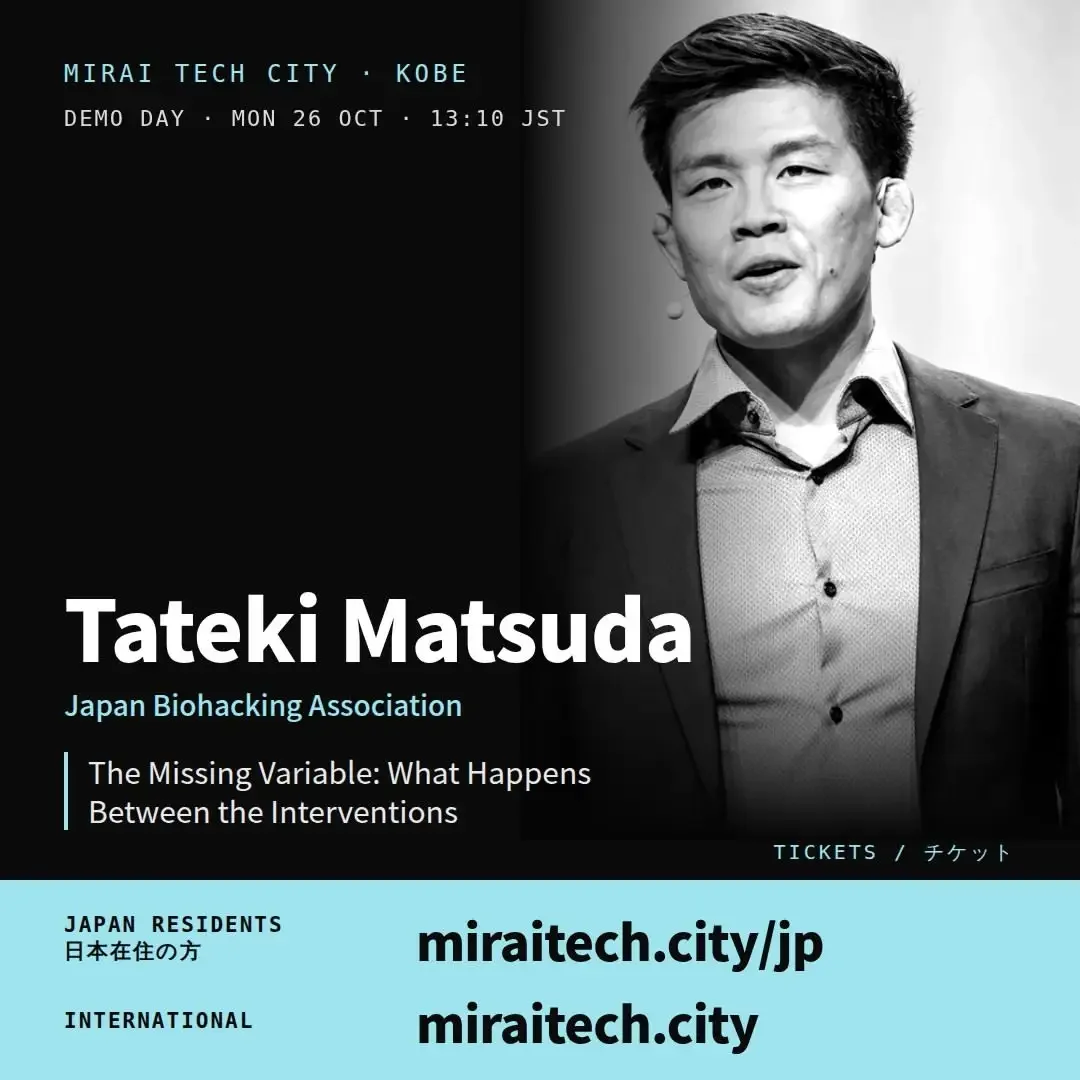
The Japan Biohacking Association published its first press release on PR TIMES on October 21, 2026, announcing its establishment and international collaboration activities.